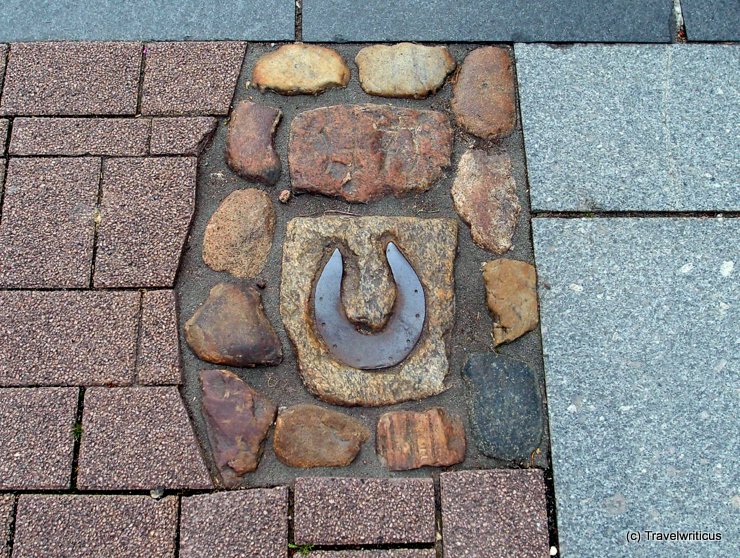
Schloss Neuhaus in Paderborn is a palace in the style of Weser Renaissance. The adjoined park formed the venue of a State Garden Show in 1994. As a result, visitors experience a relaxing walk on still splendid castle grounds.
Browse through your travel destination!

Schloss Neuhaus in Paderborn is a palace in the style of Weser Renaissance. The adjoined park formed the venue of a State Garden Show in 1994. As a result, visitors experience a relaxing walk on still splendid castle grounds.

The manhole covers in Rostock display the coat of arms of the city. The coat of arms dating back to 1367 depicts a golden griffin of a blue field (representing the former princes of Rostock) with bars of silver and red (the colours of the Hanseatic League).

Hohenzollern Castle in Heiligendamm is more a guest residence than a castle. Grand Duke Paul Friedrich commissioned the building to accommodate his noble guests. It saw its completion in the 1840s.

The church was constructed by the mendicant order of the Franciscans. That explains why there is no tower. Even though it isn’t a real cathedral, the people of Halle still call it a Dom (Cathedral).

The former armoury (Zeughaus) of Nuremberg saw its construction by Hans Dietmayer in 1588/89. After bomb damage during World War II, a reconstruction finished in 1954/55.

On a historic locomotives parade in Fürth, this engine of the German Class 41 was one of the stars. Despite being built in 1940, the freight locomotive 41 360 seemed particularly juvenile and elegant.

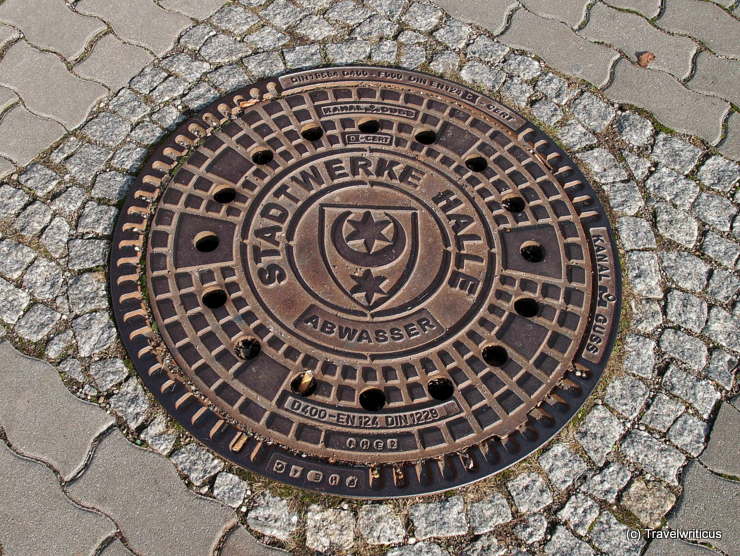
This manhole cover in Halle (Saale) displays the coat of arms of the city. The city arms of Halle consist of a moon between two stars of different size. The colour of these symbols is red, the ground is silver.

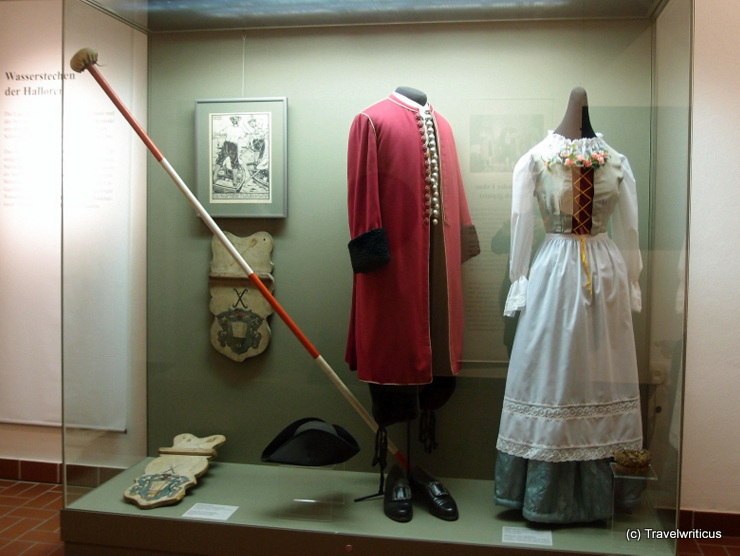
This showcase at the Hallors and Saline Museum in Halle (Saale) displays the costume of a Hallor with its typical 18 buttons and a lance. Such lances are still in use for the traditional water joustings one can experience e.g. during the lantern festival of Halle (Hallesches Laternenfest).
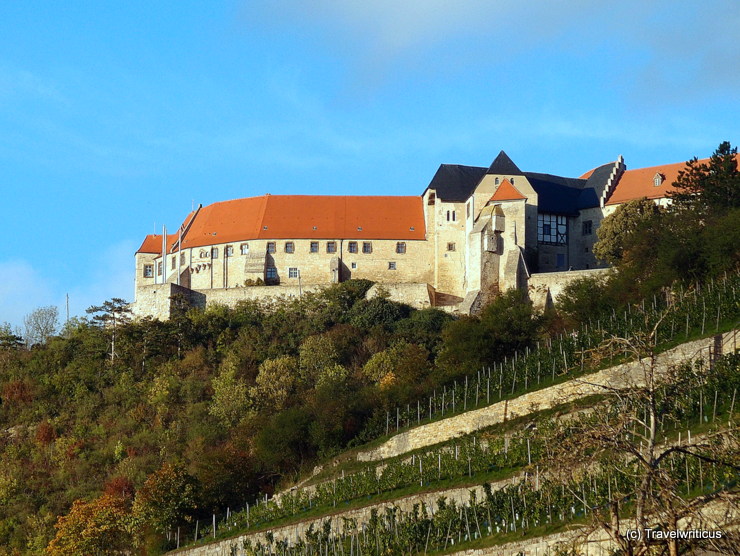
Neuenburg Castle (Schloss Neuenburg) located in the wine-growing area of Saale-Unstrut houses among others a wine museum. This photo was taken while enjoying a boat trip on the river Unstrut.
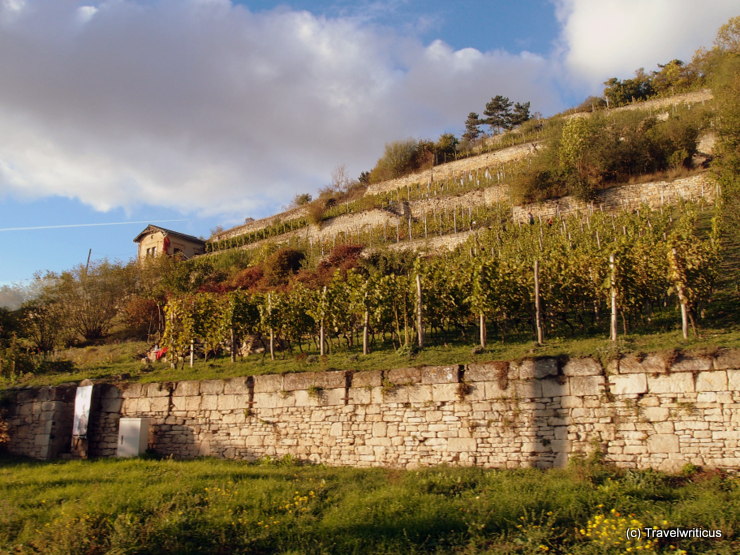
While travelling through the wine-growing area of Saale-Unstrut one can see a lot of steep terraces with centuries-old dry walls and romantic vineyard cottages. The region is open for many kinds of movement: Hiking, cycling and even canoeing.

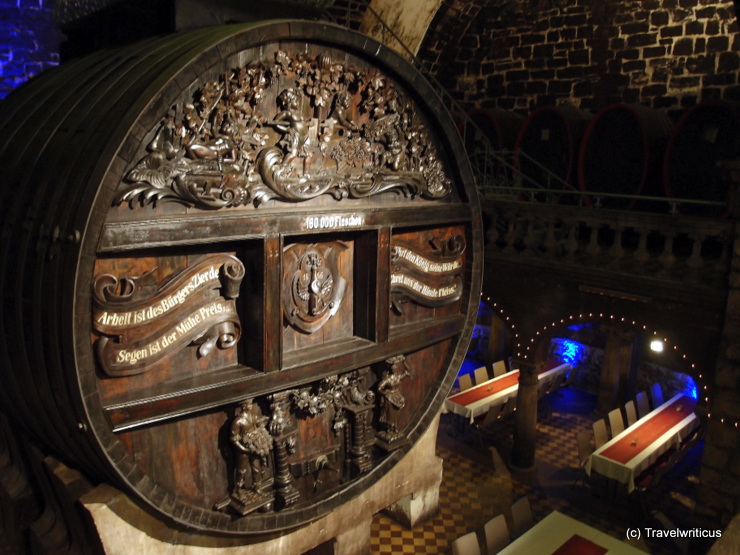
In the historic sparkling wine cellars of the Rotkäppchen winery in Freyburg (Unstrut) there is a huge wine cask for the cuvée. The barrel was built in 1897 and has a capacity of 120,000 litres.

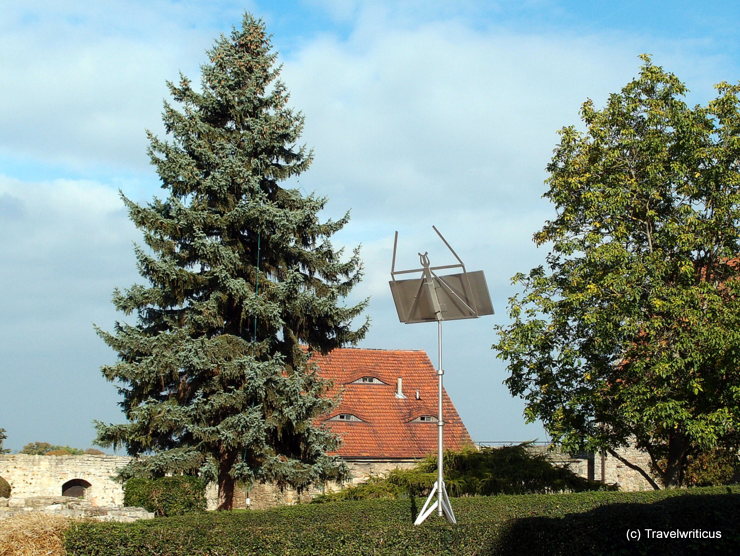
Three music stands (Notenständer) with a height of four metres remind me that Querfurt Castle (Burg Querfurt) houses a music school. Artist Ingo Güttler created these music stands that play music and form a sound installation. During festivals, the music stands will be removed.